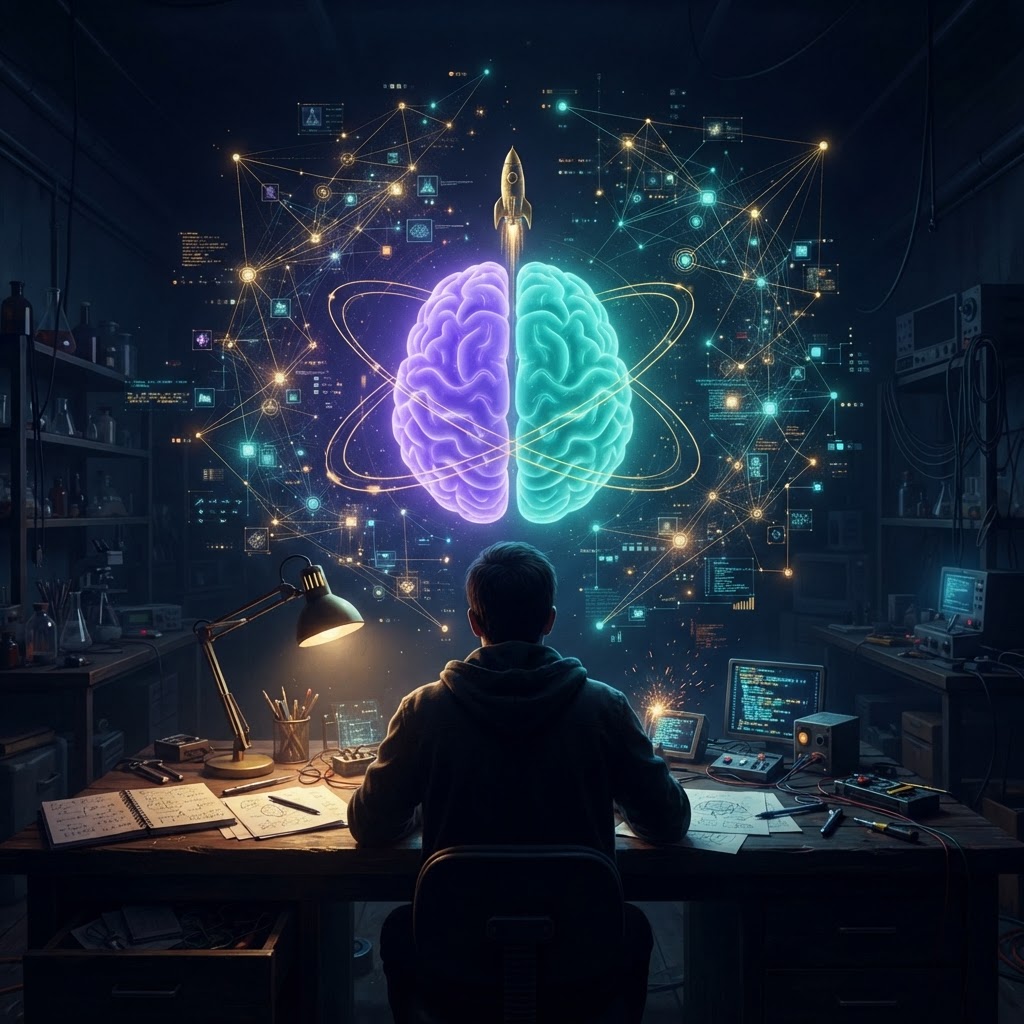
A few years ago I wrote a document I call my theory of everything. It opens with a warning in its own first line: "WARNING: This is Just a Theory and Not a Matter of Fact…yet!"
I want to tell you about it, because the interesting part isn't the theory. It's what I built to keep myself honest about it.
Here's the short version, told the way I wrote it. Two ocean creatures, back before eyes were common: one that found a single white point of light — sight — and one that carried all the other senses. They combined and started moving toward the light. Their brains overlapped into ours: two brains, billions of connections, all connected except one. The one you'd need to see the world clearly for the first time. And from then on, one side of us ran a deception race to preserve its own DNA, using the first technology — writing. The theory also carries an honesty principle I took from a near-death experience I'd describe as an ego death: it left me with a brain that never learned how to lie. And it carries color — color as the brain's real influence channel, which is why advertising works.
I know how that sounds. I wrote the warning first on purpose.
I spent seven years at SpaceX. Before that I lived underwater on submarines. Both jobs teach the same lesson: the universe doesn't care what you believe — only what you can verify. So I didn't build a cathedral to my theory. I built a courtroom.
Over the past years I've built an app with more than forty working labs — real, deterministic code you can run in a browser. Number theory. Harmonic oscillators. The Ising model, where you can watch order emerge from nothing but local rules. Chaos and turbulence. The CIE standard observer — the measured mapping from wavelength to the color you actually perceive. Cognitive labs that record your reaction time and working memory. A No Fibs lab that scores any claim for fabrication risk and refuses to invent answers. And then the lab that matters most to me: a cross-reference lab that reads my own theory and grades every single claim against the code I actually shipped. Supported. Partial. Not addressable. Contradicted.
Here's the current scoreboard, told honestly:
Color perception is genuinely supported. The app's color labs compute real color science — opponent processing, the standard observer — and influence-through-color is measurable, established fact, not mysticism.
The honesty principle is supported — as a design principle, not as a biological fact about my brain. The app enforces it in code. Every AI answer carries a basis tag: verified, inferred, or guess. No tag, no claim.
The network view of the brain is partial. Connectivity driving collective state is real — you can watch a lattice of spins magnetize yourself in the Ising lab. But no lab of mine validates "exactly one missing connection." That part is a metaphor, and the app says so.
And the origin story — the two creatures, the white point of light — isn't addressable by any lab I could build, and one piece of it is contradicted by established science. I wrote that in the app, in those words, where anyone can see it.
So what is the app for? It's the fix. Not a fix that makes the theory true — a fix for the human problem the theory points at: minds that deceive themselves, and software that helps them do it. Every page in the app has to say what it is and what it isn't. If the AI is guessing, it says so. If a number is a projection, it's labeled as a projection. If something is a parable rather than a measurement, you're told that before you read another sentence. I've spent weeks auditing my own app, page by page, fixing every place where the words promised more than the code does.
Maybe my theory of everything is wrong. Parts of it already look wrong — and I've written that down too. But the method is the point: build the thing that can tell you you're wrong, keep it public, and let anyone break it. If the theory survives being broken, it earned something. If it doesn't, I learned something. Either way — no fibs.
The labs are open. Come break my theory.
— Steve Estrada, builder of The Human Brain App