LinkedIn Article — the Red-Brown Lab
A theory, four labs, one honest upgrade.
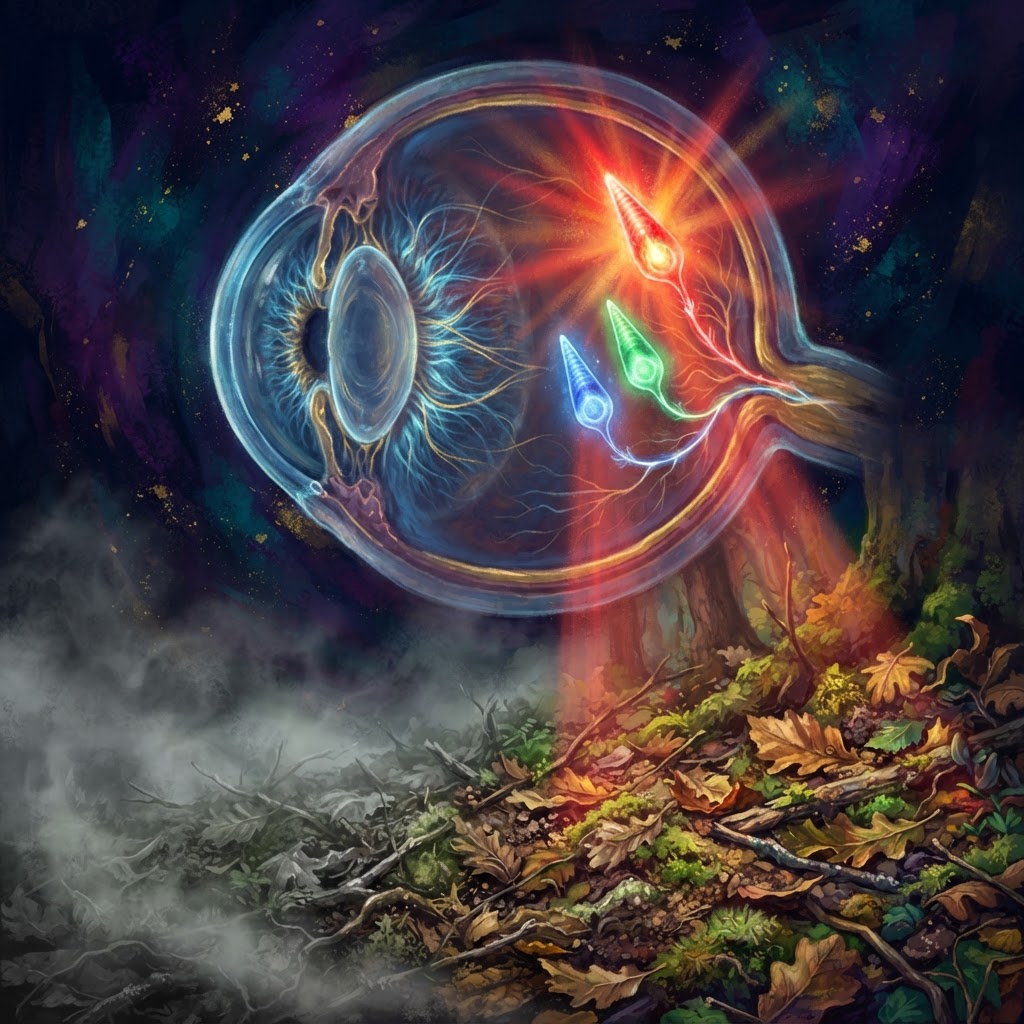
I had a theory, so I built a lab to try to break it. The theory: "Red was the last color humans needed to see all the colors of the world. This let humans see brown for the first time, since brown is a color of everything." It sounds a little out there. So I built the Red-Brown Theory Lab — four interactive experiments that test the theory against real opsin biology, real optics, and real linguistics. Everything runs live in the browser. Here's what the labs found. LAB 1 — WHEN DID RED ARRIVE? The mammalian story starts with a loss. Early mammals, living nocturnal lives, dropped from four cone types to two: a blue cone and a long-wave one. Then, 30-40 million years ago, in the ancestor of Old World primates (apes, monkeys, us), the long-wave opsin gene DUPLICATED — one copy drifted green, the other stayed red. That red cone is, literally, the newest piece of color hardware in the human lineage. The theory's first claim — red was the last cone to arrive — is not poetry. It's gene history. LAB 2 — IS BROWN EVEN REAL? Brown is not in any rainbow. Brown is what dimmed orange reads as — but ONLY against a brighter surround. The lab's brown machine: same pixels, light background = "brown," dark background = the same patch suddenly looks like dark orange. Brown is a context color, computed by comparison, not detected by a wavelength. There is no brown photon. LAB 3 — TAKE THE RED CONE AWAY Here's where the theory cracks. Using standard dichromacy simulation matrices (Machado, Oliveira & Fernandes, 2009), the lab removes the red cone from six swatches — and the browns SURVIVE. They lose separation and drift, but "brown" and "forest floor" stay visibly distinct. Red-green colorblind people see brown fine. So red did not unlock brown. The blue cone and plain brightness were already carrying most of it, and both are older than the dinosaurs. LAB 4 — THE NAMING ORDER Berlin & Kay (1969) found that every language that names colors adds its basic terms in nearly the same sequence: black/white, then RED almost immediately, then green/yellow, blue... and BROWN late, in stage five. The theory's two colors bracket the whole list — one near the start, one near the end. A striking rhyme with the theory. But honest caveat: that's the order languages NAME colors, not the order eyes saw them. Stage-five languages saw brown perfectly well before they had a word for it. THE HONEST VERDICT What holds: the red cone genuinely is the last cone evolution added to us; brown genuinely is a made, not found, color; and red-early/brown-late naming is a real, replicated cross-language finding. What breaks: "red unlocked brown" — dichromats see brown, so trichromacy didn't create it. The upgraded theory, the one that survives every lab: the red cone was the last piece of color hardware humans got, and full trichromacy sharpened brown from a vague darkness into a distinct, nameable world of earth, wood, and skin. That's the fun of building a lab before arguing: I wanted red to have unlocked brown. The lab said no. It said something better instead — brown was already there, and red is what taught us to SEE it. Try all four labs yourself (free, no account): https://thehumanbrainapp.base44.app/red-brown-lab #ColorVision #Evolution #Neuroscience #BuildInPublic #NoFibs
No-fibs disclosures
- The biology (opsin duplication, Berlin & Kay order, Machado 2009 matrices) is real science, cited in the lab itself.
- The theory is the author's own, and the article reports that the labs REFUTED part of it — including the part the author wanted to be true.
- The companion image is AI-generated illustration, labeled as such under the photo — it is art, not evidence.