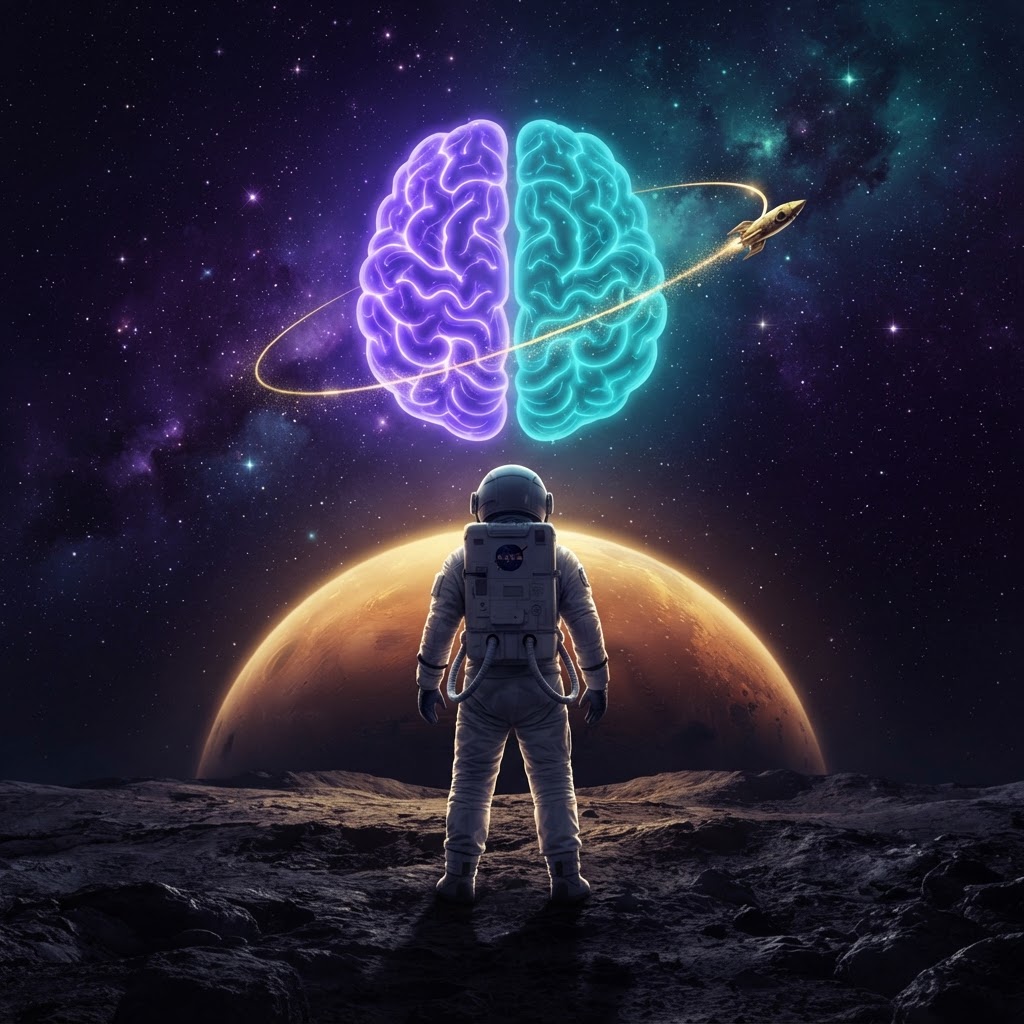
I spent seven years at SpaceX. Before that, years underwater on submarines. I know what mission-critical looks like from the inside.
So let me open with an honest disclaimer, because that's how I build everything: no app gets you to Mars. Physics does, plus thousands of engineers doing exact work with no room for error. If someone tells you their software would have shortened the path to Mars by itself, they're selling something.
But here's the counterfactual I've actually been thinking about.
At SpaceX we measured everything about the rocket. Every weld, every valve, every telemetry channel, every launch constraint. What we never measured — what nobody measures — was the operator. How tired is the engineer on console at 2 a.m. during a static fire? How degraded is your reaction time on hour eleven of a launch day? How well did that procedure you crammed last night actually stick? We had the answer for every component on the vehicle. For the human in the loop, we had vibes.
That's the gap I built the Human Brain App to poke at. It's a set of ten neuroscience labs you run on yourself: reaction time, digit span, Stroop interference, dual n-back, sleep and circadian timing, dopamine reward-prediction error, emotional regulation, memory consolidation, Bayesian decision-making. You get your own numbers. They're self-measured — it says so right on every screen, because I refuse to pretend a browser game is a clinical instrument. It isn't. It's a mirror.
Here's what I honestly believe would have been different if my old teams had this in the console room:
First, we'd have known our own baselines. Not compared to a textbook — compared to ourselves on a good day. When your reaction time drifts 15% off your personal baseline, that's data, not a feeling. You hand the console to someone fresh before the hold-down fire, not after the close call.
Second, the procedure knowledge would have actually stuck. Astronauts, console operators, and submariners all learn the same way: enormous manuals, high stakes, long gaps between uses. The app's spaced-repetition and memory-consolidation labs are built exactly for that problem — retention over months, not cramming over the weekend before the test.
Third, decisions would have carried their own uncertainty. The Bayesian decision lab makes you look at how you weight evidence and update your beliefs. In a launch environment, the biggest mistakes I ever saw weren't people lacking data — they were people holding onto a conclusion after the data had moved. Practicing that update loop is a trainable skill. Almost nobody trains it.
Would any of that have put boots on Mars? Of course not, and I won't pretend it would. It would have made the humans involved slightly more measurable, slightly more rested, slightly better calibrated. On a razor-thin enterprise like getting to another planet, "slightly" compounds across thousands of people and thousands of decisions. That's the entire argument, and its honest limit.
The next giant leap probably isn't hardware. The rockets are getting solved. The thing nobody is optimizing is the three pounds between the operator's ears. We spent seven years measuring the machine down to the last sensor. The Human Brain App is my attempt to give people a sensor for themselves.
It's live, it's free to try, and every lab tells you exactly what it is and isn't. Run your baseline tonight. Then imagine a console room that knows its own.