LinkedIn Article — the Color Obsession Lab findings
Ten zealots, one pet theory, an honest tally.
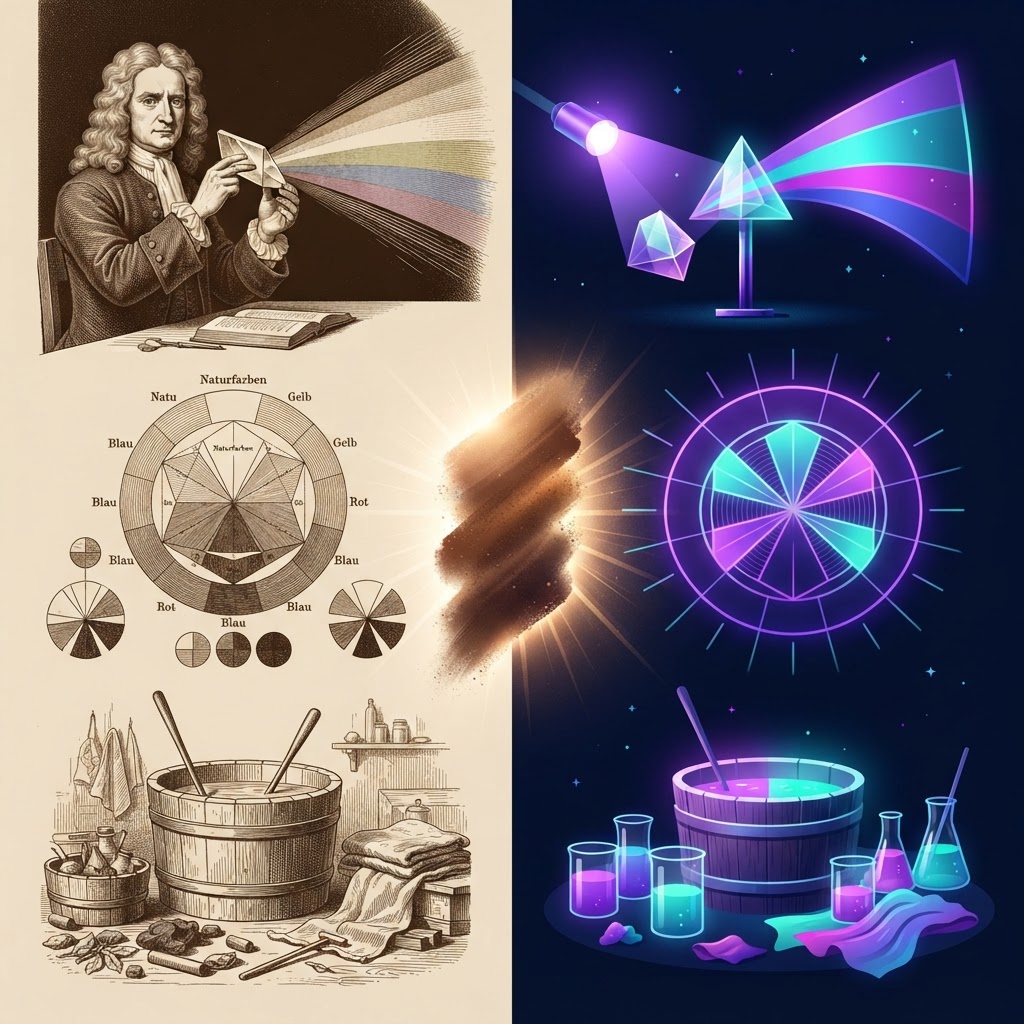
I built a hall of fame for color obsessives, then hung my own theory in it to see what would happen. The lab: The Color Obsession Lab — ten real historical figures who could not leave color alone. Newton, who slid a needle behind his own eyeball to see how vision makes color. Goethe, who spent 20 years on color and ranked that book above Faust. Chevreul, who turned a tapestry quality complaint into a law of vision. Land, who spent his final decades on why two black-and-white photographs can look full-color. Plus van Gogh, Seurat, Monet, Munsell, Kandinsky, and Itten. Every card grounded in the person's own notebooks, letters, or publications. Then I did the uncomfortable part: I quoted my own theory — "red was the last color humans needed to see all the colors of the world; this let humans see brown for the first time" — and rated where it fits against each of them. Here's the tally. FINDING 1 — THE THEORY OWES ITS TESTABLE PART TO THE ZEALOTS, NOT TO ITSELF. Four strong fits: Newton (his spectrum proves no brown wavelength exists — brown is made, not found), Goethe (the seeing mind belongs at the center), Chevreul (simultaneous contrast — brown is dimmed orange read against a lighter surround), and Land (Retinex — color computed from comparisons). The theory's defensible half, "brown is a context color," is really their machinery, independently built, centuries apart. My theory is a rhyme, not a revelation, and it's stronger for knowing that. FINDING 2 — TWO FITS, TWO SILENCES, ONE WARNING. Monet and Seurat only partially fit — their obsessions say nothing about cone evolution or naming order. Van Gogh and Munsell have no bearing at all. And Itten is the warning: his teachable harmonies hold, but his season-personality claims had no scientific support and got mass-marketed into fads. That's the shape every pet color theory fears: feeling right while outrunning the evidence. FINDING 3 — THE REFUTED HALF STAYS REFUTED. The Red-Brown Theory Lab already tested "red unlocked brown" against real opsin biology — and it broke. Colorblind people missing the red cone see brown fine. An honest lab keeps the failed half on display. The surviving version: full trichromacy sharpened brown from a vague darkness into a distinct, nameable world of earth, wood, and skin. THE META-LESSON: hang your theory next to Newton and Goethe and it gains a cohort — people who were also wrong about parts of color and right about bigger parts. Obsession doesn't buy correctness. It buys the machinery that eventually lets someone else check your work. Run the obsession lab and the theory labs yourself (free, no account): https://thehumanbrainapp.base44.app/color-obsession-lab https://thehumanbrainapp.base44.app/red-brown-lab #ColorScience #ColorVision #HistoryOfScience #BuildInPublic #NoFibs
No-fibs disclosures
- The historical facts (Newton's bodkin experiment, Goethe's 1,700 pages, Chevreul's 1839 law, Land's two-color projection) are documented in the figures' own writing and mainstream scholarship, cited in the lab itself.
- The theory is the author's own, and the article reports both the fit ratings (editorial opinions, one line each) and the refuted half — including the part the author wanted to keep.
- The companion image is AI-generated illustration, labeled as such under the photo — it is art, not evidence.